

What Are the Signs of Gum Disease, and What Can Be Done About It?
Gum disease is an infection of the tissues that hold your teeth in place.
The first signs are usually bleeding when you brush, red or puffy gums, and breath that isn't as fresh as it used to be. Caught early, it is entirely treatable and the damage can be reversed. Caught late, it is still treatable—and that is the part most people don't know. With the right care, gum disease can be stabilised, teeth can be kept, and your gums can stay healthy.
At Vere Dental in Battersea, gum treatments are led by Dr. Giuseppe Mainas, our specialist periodontist. Whether your gums have just started bleeding or you have been told you have advanced gum disease, this page explains what is happening, what treatment involves, and what results you can honestly expect.
What You Would Notice Yourself
Gum disease rarely announces itself with pain. It shows up in the mirror and on your toothbrush, long before it hurts:
- Blood when you brush — pink in the sink or on your toothbrush is never "normal", even if it has been happening for years
- Red, puffy or shiny gums — healthy gums are pink and firm, with a neat outline around each tooth
- Bad breath or a bad taste that comes back within hours of brushing
- Gums that have pulled back, making teeth look longer or creating gaps you didn't have before
- Teeth that feel loose, or that have shifted position slightly
- Sensitivity to cold, or to sweet things, at the gumline
If you have noticed any of these, your gums are telling you something. The good news is that the earlier we see it, the simpler the treatment—and the more of your gums we can save.

Why It Matters
Gum disease is one of the leading causes of tooth loss in adults in the UK. It works slowly and painlessly, dissolving the bone that anchors your teeth until, one day, a tooth that seemed fine becomes loose. That process takes years, and it is preventable at every stage along the way.
There is also a wider picture. Research has linked gum disease to conditions including heart disease, diabetes and adverse pregnancy outcomes. The relationship is complex and still being studied, but the inflammation in your gums does not stay confined to your mouth. The British Society of Periodontology and the Oral Health Foundation both publish accessible information if you would like to read more.
In short: looking after your gums is not just about keeping your teeth. It is part of looking after yourself.
What the Assessment Involves
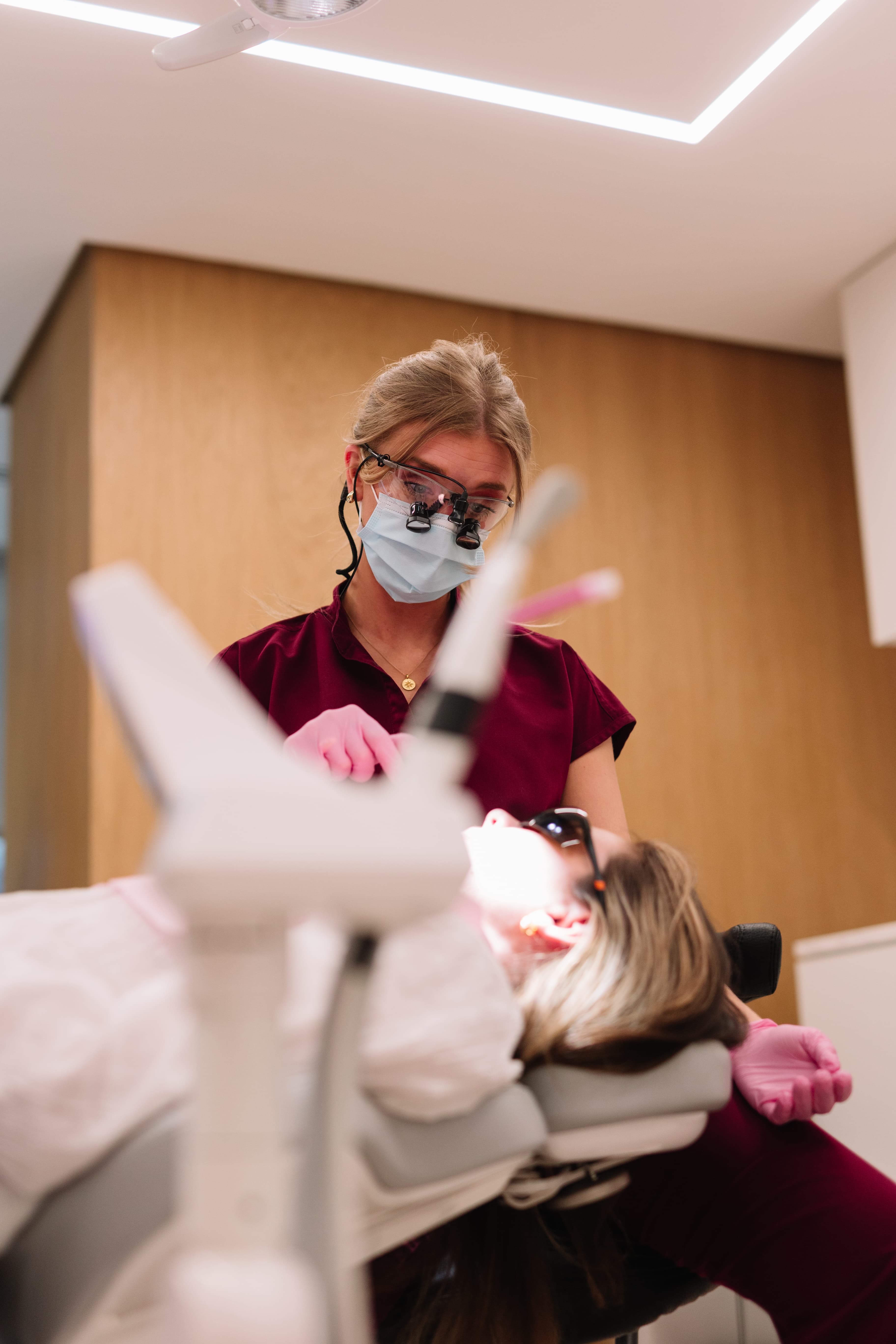
Your first appointment with Dr. Giuseppe Mainas is a periodontal assessment, and it takes about 60 minutes. It is thorough, gentle, and nothing is done to you on the day—this visit is about finding out exactly what is going on. In order, it looks like this:
- A conversation first. Dr Mainas will ask about your dental and medical history, your smoking history if relevant, and what you have noticed yourself. This is where much of the diagnosis begins.
- A detailed gum examination. Using a small measuring probe, he checks the depth of the space between the gum and tooth at six points around every tooth. These numbers tell us whether the gum attachment is healthy, and they are charted so we can compare them against every future visit.
- An assessment of bleeding and recessions is performed, recording where gums bleed when probing them and where they have pulled back.
- Specialised x-rays are if needed and if not provided by the referring dentist, to see how much bone remains around the teeth—this is something no visual examination can show.
- Mobility checks on any teeth of concern.
- Time to talk, Dr. Giuseppe will show you what he has found, explain what it means in plain terms, and outline a written plan: what treatment involves, how many visits it is likely to take to stabilise your gum health, and what it will cost will be discussed by our reception and admin staff.
This assessment picks up things a routine check-up with the dentist or hygiene treatment with the hygienist cannot.
Treatment, Stage by Stage
Stage 1: Non-Surgical Treatment
The first line of treatment is always non-surgical, and for most patients it is all that is needed.
The aim is to clean the root surfaces deep below the gumline—where your toothbrush and even a hygienist's usual clean cannot reach—so that the gums can reattach and heal. You will hear clinicians call this "root surface debridement" or "subgingival scaling" in laymen’s terms.
The mouth is treated a quarter at a time (clinicians say "quadrant"—the upper left, upper right, lower left and lower right are each treated as one area, so nothing gets rushed and the numbing stays effective). Sometimes, the treatment can also address one half of the mouth at a time. This is something Dr. Mainas will advise on. This means that each session treats one or two quadrants:
A typical course takes 2 to 4 appointments, each around 45-60 minutes
Treatment is carried out under local anaesthetic, so you should feel pressure and vibration but not pain—tell the periodontal team in the surgery at any point if you are uncomfortable, and they will stop and assess your discomfort.
Between appointments, your home care begins straight away: this is not a spectator treatment, and the combination of professional cleaning plus your daily routine is what actually heals the gums
Stage 2: Review
About 8-12 weeks after the course finishes, Dr. Giuseppe re-measures the same six points around every tooth and compares them to the chart from your assessment.
This tells us, objectively, how much the gums have healed.
When is gum surgery needed
For the small number of patients whose deepest pockets have not responded enough to non-surgical care, Dr. Giuseppe can provide periodontal surgery—small, precise procedures to access and clean the deepest areas, or to rebuild lost tissue where that is possible. It sounds more dramatic than it is: most surgical cases are done under local anaesthetic in the chair, with a recovery of a few days.
For most people, it never gets to this stage. But if it does, you are already in the right hands—there is no need to be referred elsewhere.
What Results Look Like
This is the part worth being honest about.
What improves:
Bleeding stops, or reduces dramatically—usually within weeks
Gums become firm and pink again
Pockets shrink as swelling resolves and the gum reattaches
Breath improves
The disease is stabilised: bone loss stops progressing
What does not come back:
Gum tissue and bone that have already been destroyed do not regrow on their own (though surgical techniques can rebuild tissue in selected cases)
Teeth that have become loose may firm up as inflammation resolves, but most mobility will remain
So, what does "stable" actually mean day to day?
It means your gums stop being a story. No bleeding, no progressing bone loss, teeth you can eat with confidently, and a maintenance routine with regular hygiene treatments with our hygienist that becomes as unremarkable as brushing your hair. A year after treatment, a good outcome looks like check-ups where nothing much has changed—and that is exactly the point.
Keeping It Stable
Gum disease is controlled, not cured. The patients who do best long term are the ones who stay in maintenance, and the pattern we see is consistent: the disease comes back in the patients who stop coming. It does not come back immediately—it can take a year or more—but the bacteria that caused it, repopulate the pockets, inflammation returns, and we are back where we started, often with less bone than before.
What maintenance involves:
- Review appointments, usually every 3 months to begin with, moving to 6-monthly if your gums stay stable. Dr. Giuseppe sets the interval for the hygienist based on your risk factors: how deep the pockets were, how quickly you build plaque, whether you smoke, and how effective your home care is.
- Professional cleaning of the pockets at each visit, which home care alone cannot do.
- Re-charting at intervals, so we can see any relapse in numbers rather than guess at it.

“What you do at home, every day, matters as much as what we do”
- Brush twice daily with a fluoride toothpaste, angled deliberately at the gumline
- Clean between your teeth daily with interdental brushes—this is the single highest-impact habit for gum health, and the one most people skip
- Use any prescribed mouth rinses as directed, not as a substitute for brushing and only if recommended by the periodontal team and your general dentist.
Who Treats You
Gum treatments at Vere Dental is led by Dr Giuseppe Mainas, our specialist periodontist. He actively works with our hygienists and general dentists to provide you with rounded care.
Specialist in Periodontics, on the GDC's specialist list
Qualification: Doctor of Dental Surgery (D.D.S), Master’s Degree in Periodontology and Implant Dentistry (CCST), EFP board certificate in Periodontology and Implant Dentistry, Master’s Degree in Research Designs and Analysis in Health Sciences
One thing worth knowing that is easy to miss: Dr. Giuseppe also carries out gum treatment in Italian and Spanish. If you, a family member or a friend would feel more comfortable discussing their gums in either language, just let reception know when you book.
Popular Questions
Is gum disease reversible?
The early stage—gingivitis, where gums bleed but the bone is intact—is fully reversible with cleaning and good home care. Once it has progressed to periodontitis and bone has been lost, that damage cannot be undone naturally, but the disease can almost always be stabilised and further loss prevented. That is what treatment is for.
Will I lose my teeth?
Not if we treat it and you maintain it. Tooth loss from gum disease is not inevitable—it is the outcome of untreated disease. Most patients who complete treatment and stay in maintenance keep their teeth for life, including teeth that were beginning to loosen.
Does treatment hurt?
Treatment is carried out under local anaesthetic, so the deep cleaning itself should be painless. Afterwards, your gums may feel tender, and some teeth may be sensitive to cold for a few days to a couple of weeks. This settles as the gums heal. Speak to our general dentists about the cold sensitivity as this is something we can help with.
How many appointments will I need?
Typically, if no surgery is needed, 2 to 4 treatment appointments after the initial assessment, followed by a review around 8-12 weeks later. Dr. Giuseppe will give you an exact estimate after your assessment, because the number depends on how many areas are affected and how deep the pockets are.
Can I stay with my own dentist?
Absolutely, most of our periodontal patients are referred in by their own dentist, and you go straight back to them for your routine care once treatment is complete. Dr. Giuseppe writes to your dentist with your chartings and findings at the start and end of treatment, and we are always happy to see you again if anything changes. You do not have to switch practices to have your gums treated at Vere Dental.
Ready to Book?
If your gums are bleeding, or you have been told you have gum disease and want to know what can actually be done about it, book a periodontal assessment with Dr. Giuseppe at our Battersea practice.
You can be referred by your dentist through our website, or simply email us at reception@veredental.co.uk or call 020 4505 6446 to arrange an appointment directly.



_1778164446851.JPG&w=3840&q=75&dpl=dpl_EwDSwCtuPZoyUgCu5m3Q6z1dBt5z)